50 Years Ahead Through Knowledge
50 Years of HUBER & RANNER
From greenfield to market leader
Fifty years after its foundation, HUBER & RANNER is recognized across all business areas as a true pace-setter for innovation and future-ready technology.
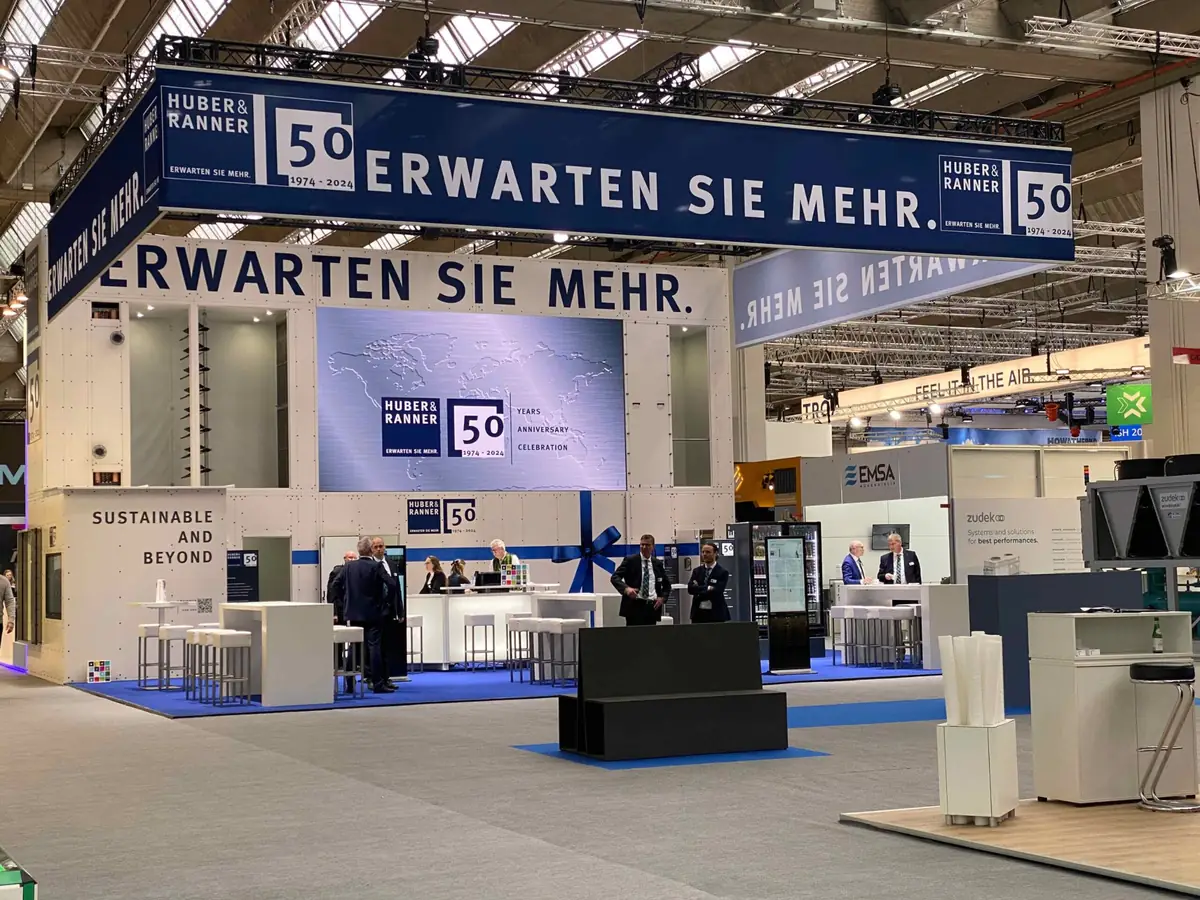
“50 years of high-tech for a sustainable future” was the guiding theme of HUBER & RANNER GmbH’s 50th anniversary celebration in Pocking, Germany. Among the approximately 500 guests were employees, long-term partners—and a delegation from the fast-growing APAC region.
“HUBER & RANNER is built on a strong team,” says Udo Ranner.
During the open-house event, visitors received exclusive insights into the production and engineering of air handling solutions—manufactured here and delivered worldwide. In Hall 3, a laser system was running live, allowing guests to watch components being cut in real time. It was also an opportunity to explore exciting career paths at HUBER & RANNER.
As a thank-you to the team, the company celebrated the day before with a traditional festival in an authentic alpine cabin.
Our energy consumption figures show that we are currently meeting this responsibility.
On a day like this, the passion for what is possible becomes visible—especially in key future industries such as regenerative battery solutions, data centres, and pioneering technologies for e-mobility manufacturing, including production solutions for electric vehicles. It shows that Bavaria is not only a strong industrial location—while HUBER & RANNER also leads with its international perspective.
In his message, the Managing Director of the Chamber of Industry and Commerce (IHK), Alexander Schreiner, highlighted HUBER & RANNER’s sustained innovation power:
“High-tech air handling equipment from Pocking in Bavaria has been shaping global markets for half a century.”
Founder Siegfried Ranner and CEO Udo Ranner reflected on the early days during the official anniversary event at the new plant (Werk II):
“More than 50 years ago we started as a craft business with so-called ventilation box units. Today, we manufacture modern air handling solutions in an industrial environment. We did this out of conviction—and in doing so, we triggered developments the district of Passau can be proud of today.”
With HUBER & RANNER technologies, the energy consumption of air handling equipment has been reduced dramatically compared to earlier generations. What once seemed like a vision—creating one of the best air handling solutions in the market—has become reality.
Measuring and improving emissions: Scope 1 and Scope 2
For around five years, HUBER & RANNER has been monitoring Scope 1 and Scope 2 emissions more closely. These include greenhouse gas emissions from operational processes and the consumption of externally purchased energy such as electricity and gas—even with extensive rooftop solar installations.
Key levers for further improvement include:
- new low-emission technologies for air handling solutions,
- building a true circular economy,
- and reducing overall energy demand.
Air Handling Units Tailored to Your Requirements
Efficiency begins in the planning stage—already when defining the investment. This is how risks are minimized and investments optimized from the start. That is system efficiency.
A practical example: to reduce pressure losses, air velocity must be lowered. HUBER & RANNER adapts unit dimensions to the millimetre to match project requirements. Even cross-section changes within one unit are possible—supporting real energy savings.
Your plant room is too low? A column is in the way? No problem. We adapt the unit precisely. And because our manufacturing processes are designed for this level of flexibility, the result remains economically viable:
- “The unit is too tall because it’s installed higher?” No problem—just adjust one parameter.
- The same applies to unit height, module length, partition positions and door dimensions.
- For easier maintenance: sight glasses can be positioned lower in doors when the unit is installed higher—again, simply by adjusting parameters.
In the market, efficiency is often seen as requiring higher-end technology and therefore higher investment cost. But that is not necessarily true—when the solution is tailored to actual requirements.
Heat exchangers are selected precisely to match the requirement. The benefit for the customer is clear: performance exactly as needed and minimal air-side resistance. Standard components are rarely a perfect fit; they are typically oversized.
Only what is truly needed is installed.
That is HUBER & RANNER’s approach: delivering the optimal solution for each project.
Our Path to a Sustainable Future (Continuation)
Sustainable resource management is one of the most important topics of our time. With energy-efficient solutions, this responsibility can be met—making a measurable contribution.
Continuous improvement of energy efficiency potentials has become the standard. Technological innovation and digitalization increasingly help to reduce energy consumption.
At the same time, sustainability reporting requirements are rising. The CSRD framework will require more transparency and measurable proof of progress.
“To successfully manage decarbonization, it takes the courage to truly transform—and to integrate decarbonization holistically into the corporate strategy.”
Interview: Questions to Mr. Huber
How did this success happen? What can we expect next?
1) Climate-neutral sustainability is on everyone’s mind. Where do you stand?
We made the decision more than 20 years ago to address this topic seriously—with a consistent focus on energy efficiency. We started by questioning existing concepts and redefining them.
We developed the air handling unit itself into a product concept that delivers economic scalability combined with project flexibility: a series-based approach—paired with modular, customized engineering. These steps pushed our development forward significantly.
Beyond that, our progress is built on practical measures: insulation, LED lighting, intelligent control, reduced compressed-air usage and more. Switching to green electricity sourced from renewable energy—locally from the nearby river Inn—adds another strong effect.
“Compared to 2015, we are already around 30% more efficient in our electricity consumption.”
2) You went even deeper into AHU design and engineering, correct?
Yes—by working on the DNA of the air handling unit. A key milestone was a revolutionary profile concept starting with the X-CASE generation (introduced in 2007), followed by HY-CASE (2010), heat recovery via GREEN KV-SYSTEM, and later SMARTRON, AIRMATIX, and advanced flexibility concepts.
With SMARTRON, we moved air handling technology forward again in 2018—actively shaping technological progress. Our goal is to create measurable value for customers and continuously inspire smarter solutions.
3) How does the energy balance of your units look today?
Energy efficiency improvements have become a clear market requirement. One important engineering aspect is airflow behaviour: as flow transitions from turbulent to laminar, energy transfer performance can change significantly—therefore we control heat exchanger performance very precisely.
Our SMARTRON run-around coil system reliably achieves the required minimum heat recovery level (68%) and supports up to the typical 75% performance level common today. It controls the glycol mass flow project-specifically within each circuit—ensuring performance where it matters.
4) How far can savings and efficiency gains realistically go?
Regulations such as EcoDesign have tightened performance requirements. The market expects increased efficiency with maximum economic viability across broad applications.
That is why we focus on the right topics: consistent alignment with real market demands and intelligent system concepts—without creating technical dead ends. All concepts are designed to remain scalable and future-proof.
5) Is that enough for every application—or can you go even further?
With GREEN KV-SYSTEM heat recovery, we already exceeded legal requirements early on. After 15 years, this concept is still fully up to date.
In 2015, HUBER & RANNER showcased AIRMATIX at ISH—a solution designed to address a major issue in the market: operators of high-efficiency systems often cannot reliably determine whether a system is running optimally, or whether corrective action is needed.
AIRMATIX enables intelligent climate operation by optimizing and validating process performance—especially by identifying inefficiencies and enabling continuous energy efficiency control. Systems can be operated permanently within the intended efficient condition—automatically.
6) All of this sounds like effort—does it fit the reality of skilled labour shortages?
Yes—and this is exactly why we developed AIR-BALANCE.
Commissioning is often delayed because skilled personnel is difficult to secure and scheduling becomes a challenge—until the automation specialist is available and installation is completed.
With AIR-BALANCE, this is solved:
- Place the unit,
- connect power,
- connect the bus cable if required,
- done.
All connections are pre-wired at the factory with coded plug connectors. This prevents errors and reduces on-site work. There are no complex wiring tasks—only plugging in. The only step requiring a certified electrician is the main power connection.
This is a practical response to skilled labour shortages: the system reduces installation time, complexity and risk—without sacrificing performance.
Expect more.
HUBER & RANNER in the APAC Region
Global demand for air handling solutions is growing. HUBER & RANNER’s development in Asia Pacific is the result of strategic partnerships and regional expansion—enabling the company to participate in the region’s dynamic growth opportunities.
Intelligent, Integrated and Highly Innovative
Battery Plant “GIGAFACTORY” Salzgitter: Volkswagen relies on axial fans in air handling systems
The battery cell factory is scheduled for completion in 2025 and represents a future-focused milestone project for Volkswagen.
HUBER & RANNER—an internationally active air handling manufacturer with a broad technology portfolio—won the contract with its ventilation solutions for battery cell production. Energy consumption is reduced through highly efficient heat recovery as well as specialized axial fan technology.
The initial construction phase includes approximately 1 million m³/h of conditioned air. The energy-saving subproject using axial fans plays a crucial role in ventilation and air-conditioning technology and was realized through HUBER & RANNER’s established partner network with Novenco in Denmark.
The customer tested one of the large systems (100,000 m³/h) in a live test setup, accompanied by TÜV Süd, directly from the Bavarian plant.
Result: requirements exceeded.
HUBER & RANNER is among the pioneers applying this technology in large volumes. Compared to the current standard, energy-saving potential of up to 20% is possible. With a new generation of air handling systems integrating high-performance axial fans, performance expectations were exceeded further.
By combining highly efficient components—such as precision impellers and IE5 motor technology—system efficiencies of up to 85% can be achieved. Through the intelligent interaction of system components and optimal integration into the air handling unit, a valuable contribution to production decarbonization was delivered.
Volkswagen is accelerating sustainability progress in the sense of CO₂ reduction, embedding innovative initiatives into its building and production infrastructure. The next 1 million m³/h for the second construction phase has already been awarded and started.
Sustainability in Focus — Expect More
We focus on developing more efficient air handling solutions—reducing resource consumption.
The requirements for new buildings have evolved rapidly due to digitalization and decarbonization. Smart buildings use cloud platforms, IoT technologies, AI-based solutions and digital controls to optimize operations.
To reach CO₂ neutrality, HUBER & RANNER believes in a holistic approach that considers the entire building infrastructure—where air handling systems play a central role. Combined with continuous monitoring, this enables long-term operational optimization.
We keep a strong focus on future customer challenges—whether in chemical industry, shopping centres, data centres or automotive manufacturing. For example, we support the automotive industry in its transformation from classic powertrains to electric mobility.
Consistently capturing opportunities in dynamic growth markets—this is HUBER & RANNER. Our technology and product portfolio is developed in line with customer needs and industry-specific requirements.
ZERO IMPACT FOOTPRINT
Precise German engineering minimizes the CO₂ footprint
Minimizing life cycle costs has long been a core focus in air handling solutions. Equally important is preventing unnecessary emissions and integrating renewable energy into the production of air handling units and their components.
In the future, it will not be enough to act more sustainably—sustainability must also be proven transparently. Therefore, HUBER & RANNER is continuously improving its reporting systems to meet rising expectations and requirements.
“Today, it is impossible to successfully bring an air handling unit to market without transparent proof that it was produced efficiently and sustainably—because planners and customers will reject it otherwise,” says Udo Ranner.
In a few steps to the goal
Mechanically assemble the modules — connect two plugs.
HUBER & RANNER Drives AI Forward
Commissioning has never been easier
The creation of future industries requires innovative solutions—open, flexible, and connected to ensure secure and sustainable operation.
With IoT-ready services such as X-CARE and FAT, HUBER & RANNER offers digital services that enable operators to unlock new possibilities and increase the energy efficiency of the complete ventilation system—especially during commissioning with AIR-BALANCE, our automation/control platform.
Beyond state-of-the-art technologies, HUBER & RANNER places strong emphasis on simple handling—enabling fast and efficient plug-and-play commissioning.
With AIR-BALANCE, connections are fully pre-wired at the factory and linked via coded plug connectors. All connections are designed to prevent mix-ups.
A communication module allows users to operate the AIR-BALANCE control system via the internet and receive alarms or status information. Users can configure commands remotely and monitor performance via i-connect.
Proactive maintenance through continuous measurement and data analysis—or predictive maintenance—offers a modern way to manage and maintain air handling units and systems.
A new era of innovation is here. In the future of building automation, it is about developing products that improve life. Think of universal, software-driven SaaS solutions with X-CARE and sustainable impact—and imagine what we can create together.
Plug & play — ready to go.
Result: significant time and cost savings.
AIR-BALANCE i-connect: start monitoring immediately.
Key FAQs for the Next 50 Years
Mr. Huber, how do you see the next 50 years of the industry—and of HUBER & RANNER?
The importance of HVAC and air handling technology will continue to grow. A new era of innovation is here. The future of air-conditioning and ventilation will focus on developing products that improve our lives.
Our industry has been “discovered.” Twenty years ago, people tried to avoid ventilation systems or keep them as small and basic as possible. Today, it is understood that air handling solutions are a key lever for energy efficiency.
Compared to 2003, when Udo and I took over the company, our industry is listened to closely when we propose ideas to improve energy performance.
In my view, the sector will continue to develop positively. We naturally follow economic cycles—but the value of indoor air technology will keep increasing. Climate change and digitalization will demand adaptation across many areas. The key is to manage this responsibly for future generations. We will contribute—and we will implement necessary changes with agility.
And HUBER & RANNER itself? Will HUBER & RANNER celebrate 100 years?
Fifty years is a long time—around one and a half generations. HUBER & RANNER will continue with the same balanced approach over the next 50 years—focused on the present, with the future in sight, open to what comes next.
Since 1974, we have been a family-owned, owner-managed company. That also means agility in decision-making and in developing innovations, products and services—and we will remain that way.
Our successors are already in place or preparing to take over, ensuring continuity. I would be delighted to be invited to the 100-year celebration—although I’m not yet sure whether I will attend at age 103.
Imprint
Responsible for content:
Huber & Ranner GmbH, Gewerbering 15, D-94060 Pocking
Tel. +49 (0) 85 31 / 705-0
info@huber-ranner.com
huber-ranner.com

